


In Part One of our Guide, we talked about helping your baby latch with some popular positions, overcoming all of those "full egg" shots on social media, & the pain that can be associated with improper latch and how to seek professional support through a lactation professional. For Part Two, we'll address common pump challenges including proper flange fit, when to replace your pump parts, proper milk storage, returning to work while breastfeeding and your rights, as well as ensuring you're caring for your mental and physical health during your postpartum care period.
How do I know my flange size?
If you haven't read our blog "Flange Size Matters," pop on over and give it a read. One of the most important things to know is that the flanges that come with your breast pump are more than likely not going to be the ones that fit your breasts. You are going to need to measure yourself after you have your baby and keep your measuring device handy for the weeks and months after, as your nipple size can change throughout the postpartum period. Amaris offers our paper flange fit ruler in every pump purchase, but if you did not receive an Amaris pump you can purchase a ruler here or use our handy printable tool here. You'll want to make sure to measure the tip of your nipple, not the base, and do so prior to a pumping or nursing session. Ensure that your nipple is able to move comfortably and freely through the circle of the measuring tool, not rubbing the sides. You do not need to size up or down, though it is helpful to keep a silicone insert kit on hand, like this one, in the event you do find more comfort in doing so.
I'm noticing my milk is not coming out as much as it used to. What could be the problem?
When was the last time you replaced your pump parts? I can see your face. It's okay. Breast pumps come with manuals, but who has the time to read them? It's important to change your pump parts frequently, depending on how often you are pumping. If you are an exclusive pumper, you will be changing them more often than someone who is just casually using their pump once or twice a day. When you notice a loss of suction, that often means your diaphragms and/or duckbill/membrane valves need to be replaced. Those little guys will need to be replaced every 2-4 weeks for frequent pumpers and can last as long as 90 days for others. Take a look at the image below for a helpful guide.
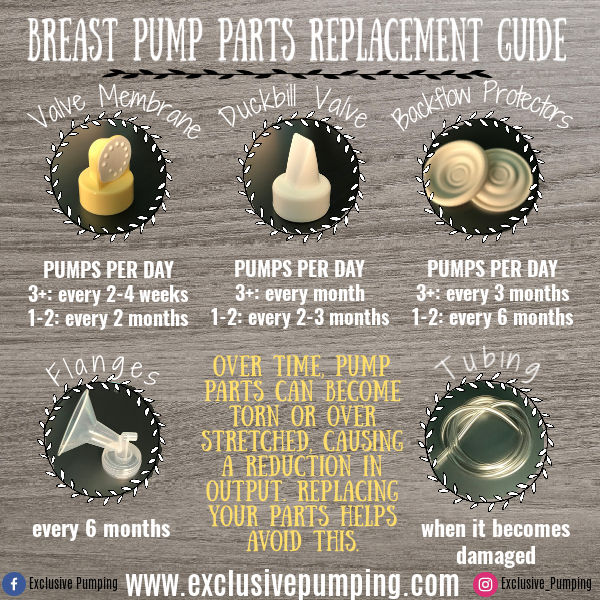
I feel like milk storage guidelines are confusing. Can I mix freshly expressed milk with refrigerated milk? What if my baby drinks some from a bottle and it sits for a couple hours?
This is such a great question and a super important one for the health of your baby. The CDC guidelines can be found here for breastmilk storage guidelines. In addition, you can utilize our helpful image below, but a few quick tips:
- Always place breastmilk in the rear of the fridge as this is the coolest place and will ensure proper temperature storage.
- Always wash your hands before expressing milk or handling expressed milk.
- If you are someone with an over-supply, consider purchasing a deep freezer. If you live in an area susceptible to natural disasters or frequent power outages, a generator might also be a wise option.
- The rule "first in, first out" is important. You want to use the "oldest" milk first.
- Never heat breastmilk in the microwave. The best way to safely warm breastmilk is to gently that it in a warm water bath.

I'm returning to work soon and I'm nervous about approaching my boss to ask for pumping privacy. I don't want to be a burden on my team members. What do I do?
It's important for the health of you and your baby that you express your milk continuously and comfortably, throughout your postpartum journey for as long as you intend. The great news is that the law protects this ability and has recently expanded it by passing The PUMP Act!
You must be provided a private space to express your milk that is not a bathroom. You must also be provided with reasonable break times, note the word "reasonable." There's no set standard for this word, so the term is left to interpretation, but for example if smokers at your job are permitted to take an unpaid 15 minute break every 2 hours, than a reasonable pump break for you would be the same. Any different and it could be a serious legal violation for your employer. You can read additional protection information here.
Don't be afraid to speak to your HR department and notify them that you'd like to utilize your rights under the PUMP Act and are requesting proper pumping space and time to express your milk. It's your right!
I thought I'd fall immediately in love with my baby, but I'm just feeling a little disconnected. My body has changed, I'm squishy, I can hardly find time to take a shower, and I feel like someone always needs me. Is this normal?
It absolutely, completely, and totally is mama! You quite literally just grew life in your body for 9+ months. For decades, your body was in charge of other things like going to school, playing sports, meeting new people, building a career, and maybe traveling the globe. It's new job was to create a safe and secure environment for growing a tiny human that one day will become a mini version of you. It's completely normal to feel all the things about all the ways in which you've changed physically, emotionally, and spiritually in this process.
But when do you know when things are getting to be too much? If you're feeling resentful towards your baby or your family or you have no interest in feeding and giving your baby the daily care they need to thrive, you might be experiencing postpartum depression. Postpartum Support International is a phenomenal resource with a live HelpLine, an app, as well as online support groups for various unique needs.
If you find yourself wanting to harm yourself or your baby, always call 911 and/or reach out to the additional resources below:


